

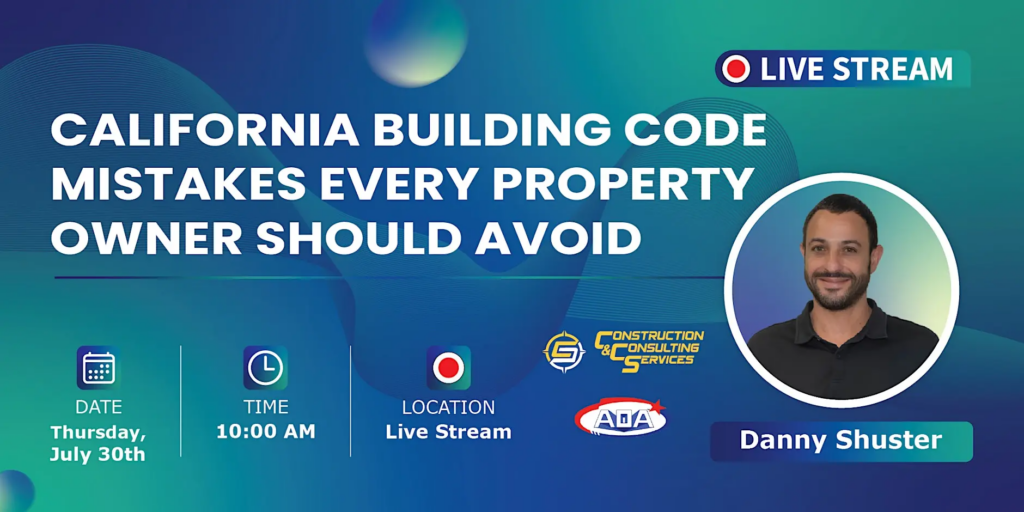
Recording Now Available – Free On Demand
The July 30 live session, hosted by the Apartment Owners Association of California (AOA) and taught by Danny Shuster, Chief Construction Officer at CCS, is now available to watch on YouTube in full. Ninety minutes on the specific California building code mistakes that quietly cost rental property owners tens of thousands of dollars per violation. If you missed the live stream, the recording is below.
What This Webinar Covered
This was a working session, not a marketing talk. Over ninety minutes, Danny walked through the three areas where California rental property owners get burned most often, using real case examples from Los Angeles County, Orange County, and Ventura County. If you own a duplex, a triplex, a small apartment building, a single-family rental, or a mixed-use property anywhere in California, the material applies directly.
- When permits are actually required – for common repairs, renovations, and property improvements – and how to avoid the “I did not know it needed a permit” excuse that shuts down every appeal.
- The building code issues that get flagged most on rental properties – safety requirements, mandatory inspections, and the compliance responsibilities that fall on the owner regardless of who does the work.
- When one repair triggers additional code upgrades – the single most expensive surprise in California code enforcement, and how to plan around it before you swing the first hammer.
Why This Session Exists
Every week, CCS gets calls from property owners who are staring at a Notice of Violation, a Stop Work Order, a large legalization bill, or a repair that turned into a much bigger code upgrade than they budgeted for. Almost every one of these calls starts the same way: “I had no idea this was required.”
The California building code is not designed to be intuitive. The rules that decide whether a permit is required, whether a repair triggers an upgrade, whether a rental property owes seismic or fire compliance work, and whether an inspector will sign off on what your contractor already built – those rules live in half a dozen different code books, updated on a three-year cycle, interpreted differently by different jurisdictions. Nobody who is not a full-time construction consultant reads all of them. That is why this webinar exists: to compress the highest-cost mistakes into ninety minutes so you never make them.
The Kinds of Mistakes This Webinar Prevents
To give you a sense of the material Danny covers on the recording, here are four real patterns CCS sees repeatedly on California rental properties:
1. “I only replaced the water heater”
Replacing a water heater in Los Angeles requires a permit, even for a like-for-like swap. California has required water heaters to be braced or strapped against earthquakes since the early 1990s (Health and Safety Code 19211), and the replacement needs a properly routed temperature-and-pressure relief discharge line. Skipping the permit tends to surface at the next inspection, sale, or insurance claim.
2. “It is just a re-roof”
A re-roof needs a permit, and it can trigger more than new shingles. Depending on how much of the roof is replaced and the climate zone, California’s Title 24 energy code can require a cool roof. In Very High Fire Hazard Severity Zones, the new roof can be required to meet a Class A fire rating. And an open permit gives the inspector a reason to look at related work. Owners regularly discover these requirements after the tear-off, when the budget is already set.
3. “The contractor said we do not need a permit for that wall”
Removing or moving a load-bearing wall, changing a wall that affects an exit path, or altering the fire-rated separation between a garage and living space all require a permit. Owners get told “it is a small non-structural partition” and then find out at sale, refinance, or the next tenant complaint that the permit history does not match the physical building – and legalizing it afterward costs far more than permitting it up front.
4. “I converted the garage myself”
Unpermitted garage conversions are one of the most common code violations on LA-area rental properties. Legalizing one usually means a full retroactive permit cycle: structural review, egress, fire separation, and energy compliance. If the garage is legalized as an ADU, state law generally does not require you to replace the lost parking; if it was converted into extra living space for the main house, the city can require that parking back. Danny covers how to evaluate the conversion you inherited, and what to do if the previous owner did not tell you.
Who This Recording Is For
- Small landlords with one to ten units in Los Angeles, Orange, Ventura, or any California county.
- Property managers who handle repairs and want to stop taking calls from angry owners after an inspection.
- Real estate investors evaluating a rental property with unknown permit history before purchase.
- Fix-and-flip operators who keep hitting “one more required upgrade” surprises during rehab.
- Homeowners who rent out a portion of their property (ADU, guesthouse, converted garage) and want to know their exposure.
If you own California rental property and you have ever been surprised by an inspection outcome, this session is aimed at you.
Your Instructor
Danny Shuster is Chief Construction Officer at CCS Inc. Construction Consulting Services. He has personally handled hundreds of code compliance projects across LA, Orange, and Ventura counties – from unpermitted garage conversions to seismic retrofits to Certificate of Occupancy corrections. When property owners get a Notice of Violation and do not know what to do, Danny is often the first call. This webinar is a distillation of the patterns he sees week after week.
About the Apartment Owners Association
The Apartment Owners Association of California (AOA) is the largest housing-provider association in the state, with over 20,000 individual members and more than 70,000 subscribers to its policy alerts. Founded in 1977, AOA runs education programs, publishes free rental forms, distributes a monthly magazine to members, and advocates for housing providers at the state and local level. This webinar was part of AOA’s ongoing education series. You do not need to be an AOA member to watch the recording, but if you own California rental property and you are not a member, it is worth a look.
Watch the Full Recording
The full ninety-minute session is on YouTube, free, no signup:
Free On-Demand Recording
California Building Code Mistakes Every Property Owner Should Avoid
Hosted by AOA • Taught by Danny Shuster, CCS • 90 minutes
Prefer to Talk to Someone About Your Specific Property?
The recording covers the patterns that apply to most California rental owners, but every property is different. If you want a straight answer on YOUR building – what permits are on file, which repairs are exposing you, whether that garage conversion needs to be legalized – book a free 15-minute consultation with our team. Bring an address; we will pull the permit history live on the call and tell you what we see.
Sources
- YouTube – Full webinar recording: California Building Code Mistakes Every Property Owner Should Avoid
- Eventbrite – Original event listing
- Apartment Owners Association of California – aoausa.com
- AOA history and mission – About AOA
Related Reading
- Unpermitted Work: How to Legalize and What It Costs
- Free Permit Lookup Tool – pull the permit history on any LA-area address.
- Free Zoning Lookup Tool – see the zoning and overlays that apply to any address.
- ADU Eligibility Check – see what your specific lot can build.
Own California rental property? Get ahead of the next code cycle.
After watching the recording, if you want CCS to pull your property’s permit history, flag the compliance issues before a city inspector does, and give you a straight answer on what needs to be fixed and what does not, book a free 15-minute consultation below.
Book a Free 15-Minute Consultation →
Or start with our free tools: Permit Lookup • Zoning Lookup • ADU Eligibility Check
Free 15-minute consultation. No pressure, just a clear next step.
A licensed compliance specialist reviews your permit history and answers your questions. We'll tell you if there's a problem - and what to do about it.